The Shore Interview #57: Aaron Tyler Hand
Questions by Ella Flores, Interview Editor
EF: Aaron, congratulations on your debut poetry collection, Floodchaser! I will gladly admit that this was a difficult book for me to put down. Even when a poem hit me in the gut, I just kept finding myself coming back for more. One of the joys I found in this book was your ability to cohere a poem titled, “Self-portrait as combination Taco Bell/Pizza Hut/KFC” (which includes a reference to Fall Out Boy), in the same collection that includes a bulk of cabin-feverish poems from the perspectives of people living on Noah’s ark. What did your process look like for sussing out which individual poems felt productive when placed alongside a tighter series? Were there any individual poems you remember being an instant “eureka!” or ones that took more convincing?
ATH: Thank you so much, I really appreciate the kind words. It takes a lot of work to put together a collection and even more to get it into the world, so hearing that it’s resonating with people means a great deal to me.
The book took many different forms over the years. Early on, it was essentially two separate projects: one centered on the Noah poems and another on the more contemporary pieces. When I shared the Noah manuscript with a mentor, they encouraged me to expand it—to bring in another voice or perspective that could sit in tension with those poems and deepen what they were doing. That idea stayed with me and I started treating the manuscript more like a puzzle, experimenting with how the contemporary poems might speak to and complicate the Noah sequence. It took a couple of years of editing and rearranging before the sections began to feel like they were in real conversation with each other.
One eureka moment came when I decided to open the book with “Predictions from a Goose Bone Prophet.” In a collection so invested in the Old Testament story of Noah, it seems obvious in retrospect to begin with a poem whose first line is “in the beginning,” but it took me a while to arrive at that. Now it’s hard to imagine the book starting anywhere else.
EF: For my second question I want to pivot to your poem that appears in our latest issue, “Mirror Lake, Oregon.” There’s this overarching thread of language being tangled with loss—from the Latin name of a winged ant, to its “legs twitching/ like an s.o.s,” to the final contemplation on the translatability of loss. Are there specific occasions, locations, or mental states that you have found facilitate a reflection on language? And what are ways you nurture that reflection into a potential poem?
ATH: I tend to become most aware of language in moments where it feels insufficient. Places like Mirror Lake are conducive to that because they sit in this tension between beauty and intrusion. You have the natural world, but it’s never untouched; there’s noise, there are people, there’s whatever you’ve carried there from elsewhere.
In that poem, I was thinking about scientific classification as a way of trying to stabilize something that is already slipping away. The winged ant becomes this kind of hinge between systems of knowledge and the immediacy of witnessing something die. And neither language nor observation quite resolves that.
As for nurturing that into a poem, it started with a question that I couldn’t answer cleanly. I tried to stay with that uncertainty rather than resolve it too quickly. The drafting process became less about explaining the experience and more about layering pressures around it (images, shifts in scale, interruptions) until the poem can hold the tension without needing to solve it.
EF: From your time in the MFA program, to your work in the carceral system, or your hosting of the Personhood Project Podcast, how do you see access to digital spaces broadening, or perhaps changing, the exposure of poetry and poetry education? And do you see any new tensions arising between different modalities and spaces?
ATH: Digital spaces have made poetry more porous. There are fewer barriers to encountering work, to sharing it, to building communities around it. I’ve seen that firsthand through things like podcasts and online publications, where conversations about poetry can reach people who might not otherwise step into a workshop or a reading.
But that increased access also changes the conditions under which poems are read. There’s often an emphasis on speed and visibility, how quickly something can circulate, how easily it can be excerpted or understood in isolation. This is especially true in the age of Instagram poets. These poems can sit uneasily alongside poems that are interested in ambiguity or that require time to unfold.
In my experience teaching and working in carceral spaces, the lack of digital access can actually foreground the value of slowness and shared attention. When you don’t have an endless feed, the poem in front of you carries more weight. The discussion around it becomes the primary mode of engagement.
So, I think the tension isn’t necessarily between “good” and “bad” modes of access, but between different temporalities. Poetry has room for both, but it’s worth being mindful of how those conditions shape what gets written, shared and remembered.
EF: Are there any journals or magazines you're currently enjoying?
ATH: There are so many amazing journals and lit mags out right now, which makes it so hard to just name a few. So I apologize in advance for any that I’m not naming here.
I feel like I have to shout out Buckman Journal. Being based in Portland, it’s especially exciting to have a journal like that in the local scene. The work they publish feels alive to place and community, but it never feels insular. There’s a lot of care in how each issue is put together, and the pieces tend to feel both accessible and formally interesting in a way that keeps me coming back.
I’ve also been reading Bat City Review quite a bit. They consistently publish work that feels adventurous without losing its emotional center. There’s a lot of range in what they take on, but it never feels scattered, just really well curated. I always come away from an issue feeling like I’ve encountered something new.
And even though they focus on prose, I’ve been really into Hex lately. I try to read across genres as much as I can, and they’re putting out some sharp, memorable work. The pieces often have this quiet intensity to them that sticks with you, and reading it has definitely influenced how I think about structure and pacing in my own writing.
EF: Please speak to how two poems in this issue of The Shore (not including your own) are in conversation with each other.
ATH: What struck me right away about “Hoof Fungus” by Becki Hawkes and “genesis throne feedback” by Dennis Hinrichsen is how differently they approach the idea of form and becoming, while still circling a similar unease about what it means to be alive inside a body or a system.
Hawkes’s poem feels grounded in the natural world, but it’s not exactly pastoral. There’s this slow, almost reluctant attention to decay (“not dramatically / but listlessly”) where growth and death are happening at the same time. The fungus isn’t traditionally beautiful, but once it’s named, it becomes something you can’t stop seeing. That act of naming feels important, like it reshapes perception, even as everything around it is breaking down.
Hinrichsen’s poem, on the other hand, feels much more abstract and associative, moving through these fragmented, almost surreal images of early formation (“that was my first / form”). It’s less anchored to a single environment and more concerned with systems, language and perception. But there’s still a similar instability there, a sense that identity is provisional, always shifting, never fully settled.
I think the two poems come into conversation through that shared tension between recognition and disorientation. In Hawkes’s poem, naming gives you a kind of foothold in a dying landscape, even if it doesn’t stop the decay. In Hinrichsen’s, language feels more slippery, something you’re testing, pressing “magnets / tight to their polarities,” trying to understand how meaning holds or ricochets.
Both poems seem interested in how we come to know the world, but neither one offers that knowledge as stable. Instead, they leave you in a space where attention itself becomes the thing that’s alive, even when everything else feels like it’s slipping.
________________________________________________________________________________________
Aaron Tyler Hand is a creative writer and literary critic with an MFA in creative writing from Texas State University. His debut poetry collection, Floodchaser, was the winner of the 2025 Catamaran Poetry Prize and is due out April 2026. His work has appeared in Attached to the Living World: A New Ecopoetry Anthology, Poem-a-Day, Texas, Being: A State of Poems, San Antonio Express-News, Gasher Journal and elsewhere. You can hear him talk about poetry on The Personhood Project podcast and keep tabs on his future publications at www.aarontylerhand.com.
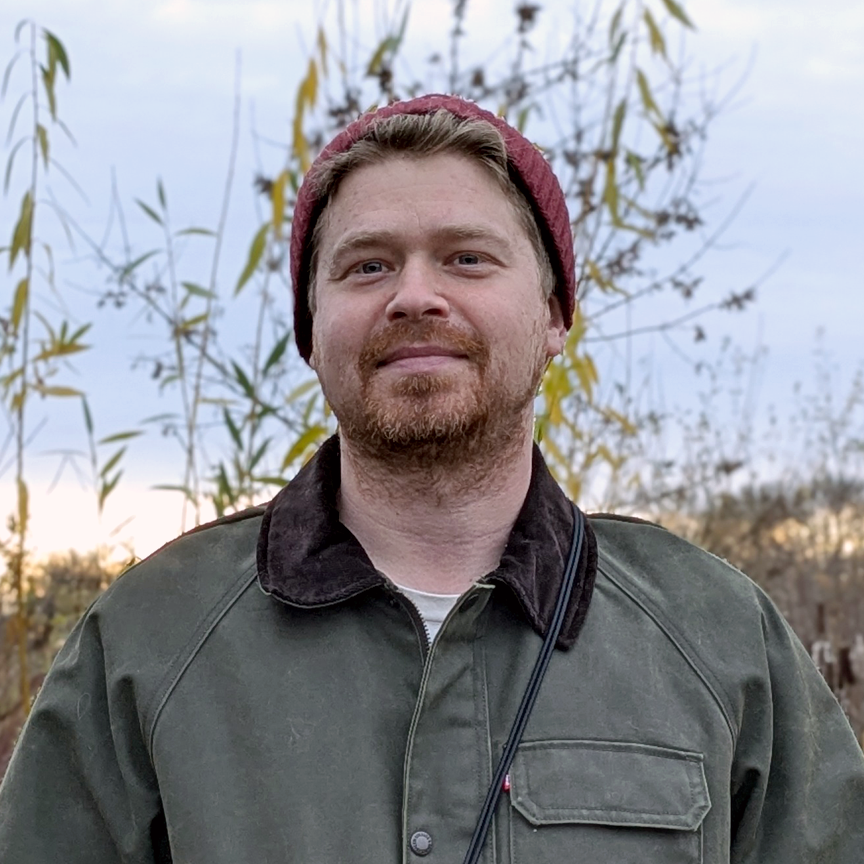
Aaron Tyler Hand