Issue 18 Full Text
________________________________________________________________________________________
Haley Winans
While I Watch Flesh Erode off a Raccoon Skull in a Pickle Jar
Past the highway hugged by cranes
and foreclosed farms, off the cloud-
clotted vein of Skyline Drive,
tucked beneath the Blue
Ridge’s bruised mouth
of cavities, lies a national dark
zone where we were hunting for skulls
in the decay of oaks and dogwoods, near the end
of hoof crumb trails where the deer
laid down surrender-slow
and dissipated into the cold spring
air like wrongful innocence.
I couldn’t see a deer’s gleaming
wet nose if it licked my face.
I couldn’t see you hide
behind trees twenty feet from me,
watching me panic through bramble
like a half-dead possum. Pecking at my fear
like a sadistic turkey vulture. I saw the prettiest prey
in myself, tarred in the root-rot
of passivity, feathered in vibrant
scarves and fleece. Failing to find
you in such silence, a pitch-
black scrap of night, the crunch of dead
leaves like radio static.
In this dark I wanted God
to surgically pluck me from this forest
like a slow game of Operation,
tweeze me from the wound-
red walls of maples, bait me home
with the promise
of sunbathing in the glow of a love
more sacred and scintillating than the dried spit
of Saturn and stars on the sky’s black sheet.
________________________________________________________________________________________
Haley Winans
Earth Dumps Humanity
You’re so brave and selfless:
the way you recycle
pizza boxes, refuse straws
for your mocktail at gentrified
dive bars, bike to Fresh
Market with your dad’s credit
card, go vegan in the heart
of a food desert, stay
tapeworming my soft
tissue of wealthy-preserved
greenswards and duck ponds.
You motor-throat my name
like hard metal
elegy. You’re a hot January
day ornate with the premature fur
of cherry blossoms stippling
the skyline: a blinding
beautiful pastoral of red flags. You loved
to get a rise out of me; watch me
blush climate maps or heat waves or eat a family
of polar bears like a Ziploc bag of trail
mix while a cricket sound
machine and my tidal sweeps
of fingertips lull you
to sleep. But you and I—we’re Pangea
babe. Broken
up and never shifting back
together till you’re buried
in me. You think you can gaslight
a geo-queen? You pretend you’re a man-
o-war booze-cruising my currents
but you’re just a plastic
bag. All float, no sting.
________________________________________________________________________________________
Haley Winans is a garden-lover and bunny mom from Annapolis, Maryland. She has poetry published in Slipstream, The Shore Poetry, Breakwater Review, Folio Literary Journal, Minnesota Review and elsewhere. She just graduated from the University of Memphis MFA Creative Writing program. She's a founding co-editor of Beaver Magazine. In undergrad, she studied Environmental Studies and Creative Writing, with a hyper-focus on environmental justice, sustainable agriculture and poetry. Twitter: winans_haley
________________________________________________________________________________________
Sara Femenella
Infidel
I spent my fertile years pulling spines out of the backs of goddesses,
trading uteruses under the gaze of men who took their best virginities
along with a handful of pomegranate seeds, another ruined woman
rising whole cloth from their legislation.
I tell my husband how I like it, soft, slow, faster. First I loved
the saints, then the gods, then the men who drew moans from
the parts of me where a stag bleeds in the moonlight. I like the violations.
I take my ruin well. Still, I never thought it would go this far.
The child bending to give the mother the spoon.
The mother wringing the uterus out over the sink.
Like most women, I’ve made a lot of bargains when it comes
to the uterus and now I’m looking for someone to blame.
Who took this body, left it to and fro and zoned for something else?
What would I do differently if I could go back to the beginning?
At night when my husband rolls my body onto his I want
to sink myself into him, to descend down to the beds before ours,
down to the first time where there was the bed and there was
the man binding me to the story of the bed, there was the dark
and there was my body’s pleasure where the bed met the edge
of the forest, there was heel of a hand pressed to the back of my neck,
there was my ear pressed to the black haunt of the earth,
my tongue tied by the strings I would not learn to untangle
for years, there was the stag lowering his head to drink
from the stream. There was not even blood.
________________________________________________________________________________________
Sara Femenella's poems have been published in Pleiades, The Journal, The New Orleans Review, The Saint Ann’s Review, Denver Quarterly, Salamander and Seventh Wave, among others. She lives in Los Angeles with her husband and son.
________________________________________________________________________________________
Dorsey Craft
Taking Stock, Seven Months Postpartum
I am a tin can after a can opener,
lowest left rib popped out beneath
the swollen left breast, twice as large
as the right, milk-giver, endless
breakfast machine, nipples pink again,
permanently knobbed and I can’t
imagine ever allowing a lover
to place one between their lips,
or if I would even feel it. When you
first latched, in the NICU, the pleasure
came uncanny as a pomegranate,
seeds piling one by one against
the blasted tree of my desire before
I burned raw from the dry suck
of the pump. My waist is lower
on the left than the right. My dresses
all fit again, but I no longer love them:
bluebottle, ivy, marigold, asinine
like my chest-length hair that I’ve cut
to the chin I once felt something warm
dribble onto while breastfeeding--blood
flooded out of my nose onto the wisteria
of veins at your temple. My shirt ran dark.
Red flowering deep in your hair, you drank.
________________________________________________________________________________________
Dorsey Craft
NICU
Time piles on
our shoulders—
frigid drift,
slow pulse,
frozen veins.
They stick
and stick you,
their needles
beak-thin. You
swell. Less
stimulus they say.
He needs rest.
Monitors trill
electric. I am
ancient—
shark-mottled
under ice, a listless,
gasping, mindless
thing that chases
the deepest,
bluest pain.
________________________________________________________________________________________
Dorsey Craft is the author of Plunder (Bauhan Publishing 2020), which was the winner of the May Sarton NH Poetry Prize. Her work has appeared or is forthcoming in Blackbird, Cincinnati Review, Copper Nickel, Pleiades, Poetry Northwest and elsewhere. She teaches at the University of North Florida, serves as Assistant Poetry Editor of Agni and co-organizes the Dreamboat Reading Series with Jessica Q. Stark in Jacksonville, FL.
________________________________________________________________________________________
Lisa Lewis
When We Were Southerners
It’s what they argued about.
It could happen anywhere, but I remember it in the car
crossing railroad tracks.
My grandfather, railroad foreman,
lectures on the importance of not stopping there at a red light.
He glitters like an old tree dropping needles. This is the family outrage:
the suffering that comes of stupidity.
Who would do this
look at the car smashed to tin foil, no don’t look
you might see something
There’s no reason for words they think of when they think of the side of town
we stay away from
to come up
except they always can when you’re white
in Virginia in the 1960s.
I am the reason
there’s something wrong with my grandfather’s version of the word
my grandmother pronounces with an a to close, not an r.
She doesn’t say it’s not racist because nobody says that word in our car.
I’m the one in the car with the reputation for knowing words,
but I’m eight.
Also, my mother.
Driving, hands hard on the wheel, face hard on her head.
Born there, I don’t know how I got out or how far, not enough.
Got out of the state, got out
of not knowing what was wrong, there in the car not parked on the tracks,
but sitting there staring
out the window at the flashing lights and the gates dropping down like angry hands,
like birds of prey, like falling trees,
it was all wrong, like barbed wire in their mouths, the side of town
we didn’t visit shining out there like a lighthouse painted bright colors
white people didn’t trust. Why do they do it? I asked.
Nobody said because
who wants to be like us?
I was the wrong who knew we were wrong.
If you broke the egg on the sidewalk, you’d have to run.
The last time I really saw the place I broke a window to get in.
You have to tell it sometime. What we had was white and they liked
to talk about it by talking about what they weren’t. They needed a reminder.
They wanted to fit into white like paper I learned to write on.
White in the downstairs bathroom, white like a key in a white lock that opened.
Why talk about it now? Why can’t I just stop?
This talk of white, this need
to steal anything that’s not nailed down and stuff it in the white bag, the white box,
the white bank carved from white stone.
There is no taking it back, no cleansing ritual, no change to the old calendars
or the old dictionaries or the old dead, the old old wrong wrong dead.
And my friend too, who took me to Wilmington to show me
the gravesites of her ancestors. I didn’t
ask. I had already chided her for something she said. My unpleasant
necessary habit. She had already
conceded she was wrong. She read the right books, or said she did.
She wanted to live in Wilmington then, she wanted a job, something to pay the bills,
but it didn’t work out because she still had some lots left from the old place
she inherited. Last year she died there, on the floor.
Those grounds never felt safe underfoot.
It’s what you don’t know, exactly, but you know how it went.
Accusations, closed hands, words, words, and more words.
How could you possibly pronounce them? What were the many ways?
________________________________________________________________________________________
Lisa Lewis has published eight collections of poetry, most recently Taxonomy of the Missing (WordWorks, 2018) and a chapbook, The Borrowing Days (Emrys, 2021). Recent work appears or is forthcoming in National Poetry Review, Cream City Review, Puerto del Sol, Southern Florida Poetry Journal, Florida Review, Isele, Diode and elsewhere. She directs the creative writing program at Oklahoma State University and serves as editor of the Cimarron Review.
________________________________________________________________________________________
William Littlejohn-Oram
Neon Moon with Cicadas
Another crane fly died outside,
lured to the motel’s neon blue,
the sound momentarily popping
over that of the cicada’s buckling ribs.
I lie sprawled
over the cheap wooden chairs
set by the open window
facing the street corner.
Across the intersection, the restaurant’s
electric beer signs out front
only flicker now, half-hearted in their job.
The stone chapel in the graveyard stood
until expansion of the grounds. Its steeple
had fallen off anyway and its paint peeled.
Wallpaper, too, begins to peel away
near the ceiling around the motel room.
The desert flowers by the television set
have wilted down onto the coffee pot.
The ceiling’s dark stain has grown.
I decide that I too will grow old here.
My skin aged, speckled and grey,
I will memorize the backs of my hands,
the wrinkles, the scabs, how it folds
or tears, soft like leather,
while through the open windows will come
songs of evening cicadas and the beating
of the broken traffic light, blinking red.
________________________________________________________________________________________
William Littlejohn-Oram earned a degree in Fiction from the University of Houston and a Master’s in Poetry from Texas Tech University. He is currently found in Fort Worth, TX wearing brightly colored shoes. His work has appeared with or is forthcoming with EcoTheo, Muzzle Magazine, The Shore, The Windhover and others.
________________________________________________________________________________________
Laura Apol
Regret
It was my clavicle you loved best, blue-tinged
shadow at the base of my throat, a place you said
tasted of lemons and rain. That day in the woodshed,
rusted trowel in hand, I told you about the bloodied lip
and you told me about your new life. I wasn’t ready yet
to go. But way leads on to way: a gravel drive
and a red wheelbarrow to a path over the stream,
the empty field stretching beyond. I want you
to know: our orioles return each May; as always,
I slice oranges, put out sugar water. They leave each June—
one morning I realize they are gone. After so many years
I am still surprised.
________________________________________________________________________________________
Laura Apol is a widely-published poet, writer and associate professor at Michigan State University. Her work has appeared in numerous literary journals and she is the author of several prize-winning collections of poetry, most recently A Fine Yellow Dust (2021, winner of the Midwest Book Award). A past poet laureate for the Lansing-area, Laura conducts creative writing workshops internationally, nationally and locally.
________________________________________________________________________________________
Matthew Gustafson
Poem from the Edge of Things
The churches are empty
on the plains tonight.
A cold wind rides
up the coasts, shivers
the click beetles
into the hollow air.
A daggered moon
pierces the horizon
and the whole world
banks on dark.
There was a god
I held together once,
the way the wind
holds thick hair,
but that’s all long since
been unmade.
By now, I should have
long since been unmade,
but I’m still here, held
in the wind.
Those churches are,
too.
________________________________________________________________________________________
Matthew Gustafson is a graduate of Lafayette College and a current student at Stony Brook University’s MFA program in Creative Writing and Literature. He has been published in Long River Review and is hoping to get out of this cafe before he becomes part of the decor.
________________________________________________________________________________________
Tracey Knapp
Best Audience
Sometimes you just want to talk to someone—
a mime in the stairwell, your diabetic cousin,
the man on the train who groans as he falls back
into the seat as the train lurches onward. You don’t ask
if he is okay. Never run on pavement, he says.
You don’t have to worry about that, you don’t say,
still uninspired by treadmills, still thinking
in patterns, stupid choices on replay. Still complaining
to your coworker about Coke Zero and the latest revolt
on grains. Also, you are scatterbrained and it’s not
reversing. Later, you remember you left your
phone on your desk and there’s only one person to blame.
There’s only one person to blame and you mutter all the way
back to the office, no one to talk to. Then someone offers
you a handful of popcorn, and you’re talking to someone
about more butter. You’re talking to ducks
the next day by the lake! You see your friend
in the cereal aisle. He says he’s doing okay.
You like talking to others when it’s too hard to talk
to yourself, when there are only mean things to say.
________________________________________________________________________________________
Tracey Knapp
Answer the Question
Did you ever ask your mother what a lover was?
Why her eyes turned black when she smoked
over the sink? Did your brother tell you why
he shot his finger, or burned a hole in his plastic
clock? Did your father show you how to load
the ornamental bullets from the belt of his
officers’ gun? Why did you smash slate with a hammer?
Can you name your scars and their reasons? Why
would you nail your dolls to trees? Why did you stop
tap dancing? Where were you when Jack and Jennifer
first kissed on Days of Our Lives? On the couch with
your hands down your pants: yes or no? Skittles or
Starbursts? Pick one. What about the first time a bee
stung your ankle in an old tire? Or falling off the picnic table:
do you just recall the story of it, or the fierce pinch
of stitches on your head? Was the hose left on to flood
the small lilies or water the salamanders under the old wheel?
You forgot your first doll’s name: true or false.
Yes or no: the window to the roof was a portal to the stars.
Did you see many shooting stars? Yes. Many, many
shooting stars. Lovers, yes, light years later.
________________________________________________________________________________________
Tracey Knapp lives in Northern California. Her first collection of poems, Mouth (2015), won the 42 Miles Press Poetry Award. Recent work has appeared in On the Seawall, New Ohio Review and Rattle.
________________________________________________________________________________________
Sandra Fees
Empty Sky
There never was an empty
sky. Looking back now
we can see it was always
a hummingbird
emitting a spectrum
of light, iron for our blood,
calcium for the bones.
We, an explosion
in time no matter how
far back we go. Elders
once
bent to dust. Or ovum. The seismic
shifts, the weave of space. Like
all forgotten things. Boundaries
blurred, prophecies
unbroken.
We were children
once
and pressed our backs
to grass, to galaxies.
Let’s start again.
The hours migrate
backward. We, novices
and nomads. And
the beginning
of the beginning
plays out
all over again
above us where stars
crinkle in the reflective
pond where we wish
immortality swirled
where we are pulse-
beats, race and arc, we.
________________________________________________________________________________________
Sandra Fees
Deskwork
Every inkling of want leads back
to this table I write on. Above,
nameless, hovers a body
of work. One day
the body is a ghost disbursing
dandelion seeds to whim
to wind, the next feathered
and gliding. Today a fragrance
but indiscernible. Where it
comes from, where it’s
going I’m still not sure
but the future is starved,
calls me back, promises
not to devour me.
________________________________________________________________________________________
Sandra Fees
“Your Body Knows You’re Burned Out”
—New York Times headline
Inside, there is a parking lot.
A letter without an address.
There is flint. And foam.
But no spark, no drink.
There, a covered bridge
spans the waters
and an instrument
wants lips of devotion.
There, a bird
that rarely flies
swims gracefully.
There, a whistle
catches in the throat.
My ears are wheels.
They spin their warnings
in mind in mud.
________________________________________________________________________________________
Sandra Fees has been published in Nimrod, Crab Creek Review, River Heron Review, Border Crossing, Whale Road Review, Moon City Review and elsewhere. The author of the chapbook, The Temporary Vase of Hands, she lives in southeastern Pennsylvania.
________________________________________________________________________________________
Roman Bobek
When a tree dies,
my grandfather tells me
I won't notice because
it will stand for many years.
Yes, I’ll notice the bark wrinkling,
the mossy scruff fraying,
but it’s been old ever since
I was born,
and long before that.
Yes, I’ll notice fewer and fewer leaves,
but its body will still bend in the wind,
humming a song in
that language I can’t understand,
that language that beats beneath my tongue.
And one day, I’ll notice the morels
lying at its feet and think
it’s gathered them all just for me,
but when I peer into
the hollows and call its name,
only the birds will answer.
________________________________________________________________________________________
Roman Bobek is a poet from Medford, Oregon living in the Czech Republic. He majored in Creative Writing & English at The George Washington University where he received the Vivian Nellis Memorial Prize.
________________________________________________________________________________________
Jordan Walker
In This Room
There is something about an Autumn wind
swept beneath mushroom caps, collecting
in spores and spitting us out—
tiny parachutes of pappus.
Our limbs are loose
whirligigs; single-winged
and spiraling under rivering mounds
of flesh and collarbone.
We guess who will stay
aloft the longest.
A chokeberry grows
from your mouth,
your chest erupts
in clusters of red anthers,
my gangly knuckles ache
and crack over you,
a mantle of soft belly and sinewy shoulders.
I am in awe of this change,
of this body
that was just a season ago
dark green elliptic leaves and white floret,
now hulling over my hips
in heavy need.
In this room, we need not speak.
We drag our wooly mouths across
each other,
dandelions in our throats.
Our tongues
twirl down thistles of hair
lapping at hayweed,
and suddenly we are children,
our fingers competing
for light on the body.
________________________________________________________________________________________
Jordan Walker
Consultation
I am eleven, blue eyeliner cooking
under the curing light—
I have just learned
my teeth are in question.
the dentist warns—
If you don’t get braces,
you might develop a man’s jaw,
a chiseled chin, a hardy profile.
He shines these words on me
as if they are unclean, as if
they don’t thrill me,
and I feel silly. You don’t want
that, do you?
I nod, learning again
how the body can’t be trusted.
Three years, promises just a little pain,
then beauty—a no-brainer.
My mouth is forced open.
The green slime piles to the brim, drips
and globs down into my throat as I gag
silently—my eyes bulging and
drool pooling on the medical bib.
When it’s all done, the green putty hardens
into a mold on the counter and we joke
like adults at dinner,
me and him. I’m trying on
that new laugh I’ve been practicing.
The one that sounds like Blake Lively,
throaty, boyish. I don’t tell him
I find her voice delicious, that I want to lay against
every corner of her mouth like a tongue
depressor, feel her breath
on my cheek, die there.
It will be a decade before my mouth opens
in the ways it wants to, has always
wanted to. But in this room smelling
of melted crayon and chlorine,
I pretend to be good,
my thumb pressed white
beneath my fingers,
steeling myself
into something straighter.
________________________________________________________________________________________
Jordan Walker is an MFA candidate at the University of North Carolina Wilmington, where they work as a graduate teaching assistant and instructor of creative writing.
________________________________________________________________________________________
Emily A Benton
Back Country
Where once gravel, now
double lines of yellow paint
and asphalt glimmer with heat.
Where you were taught
to mind No Trespassing signs
bordering Miss Hixon’s property—
where you learned how to step over
barbed wire, over rosebush, and to crouch
in the pines at each truck’s passing—
dozers now congregate empty plots
surrounding a man-made lake.
You stand at the gate, stubborn,
waiting for her horses to nudge
a wild apple free from your knuckles,
though Miss Hixon’s long gone—
her sassafras weeded from
the mouth of the city mower—
and what runs toward you growls
and bites at the air, its hair raised
in fear of your foreign scent.
________________________________________________________________________________________
Emily A Benton
Great Wave
after Katsushika Hokusai
Not a quake nor a storm nor any major event
other than the wind conjures up your woodblock
with its whitecaps against an imperial blue.
Printed more than a hundred Junes ago
on mall kiosk calendars, your art is a souvenir
for what isn’t even there. Imaginary, the critics say.
Scientists use words like laminar or irrotational
but still fail to capture it. Old navigators could
predict one by placing an ear to the cupped palm
of their canoes. But what I really believe is
something else must’ve been burning you
like the contrails behind a man-of-war.
I get that, too, even with my heels in the sand,
watching my beloved dip under shallow breaks.
Somewhere off the contour of this island,
an argument builds against the coral, and
a man like you holds his breath, waiting his turn.
Another way of looking at a mountain.
________________________________________________________________________________________
Emily A Benton is a poetry editor for storySouth and a former editor for The Greensboro Review and the University of Hawai‘i Press. Her poems have appeared in journals such as ZYZZYVA, Hayden’s Ferry Review, Harpur Palate and Southern Poetry Review. Raised in Tennessee and a graduate of the MFA Writing Program at UNC Greensboro, she lived and worked in Hawai‘i from 2012 to 2020. She now resides in Georgia. Find more at emilyabenton.com.
________________________________________________________________________________________
Jeff Newberry
To Build a Tower
—The (Little) Tower of Babel (1563), Pieter Bruegel the Elder
It all begins with sound.
From the wondering “hmmm”
before pencil scores paper, before
drawing becomes blueprint, to the final grunt
a stonemason exhales before they call the work
done. Consider the symmetry
of this tower, rising into the weather. Clouds
form and curious birds must light on cornices
to sing strange songs. This far up,
the world reduces itself to idea—
the outline of what might be dwellings.
Even the landscape an artistic afterthought,
a rough sketch to make it all look real.
The tiny galleons gather in a shadowed port,
laden with people and their projects,
the bakers who feed the workers
who vocalize the architect’s fancy.
This far up, no one would hear a gull’s scream
or note a galley boy dumping trash
his family could never afford.
A single missed cue would find them
dashed into each other, crashed,
sunk into a sea no one at work
above would hear above the wind.
Nothing the creator would hear,
lost (as he is) in plans and blueprints.
Perhaps the workers sing to each other
as, brick by brick, wooden slat by slat,
this god-feared thing punctures the sky.
Their words would compete with the wind’s
insistence, their verses nothing more
than mnemonic, reminding them
where the song is, or where it should be.
The architect would eventually lose
sight, too, down below, gazing up
and seeking words to call it: monstrous,
bigger than life, enormous, huge.
How language fails in the face of realized
vision. How the gods fall silent
and jealous the closer we get to speech.
________________________________________________________________________________________
Jeff Newberry is the author most recently of How to Talk About the Dead (Red Hawk Publications, forthcoming Fall 2023). An essayist, novelist and poet, his writing has appeared in a wide variety of print and online journals, including Brevity: Concise Nonfiction, Sweet: A Literary Confection, Red Rock Review and Laurel Review.
________________________________________________________________________________________
Christopher McCormick
Tick Season
Springs got a grin
full of honeybees
and frogs fucking
on their slippery beds.
Suddenly, it’s April
and we’re innocent again
carrying the soft words
dandelions love to chew on
listening to flies cuss
in the almost-holy light.
We brought a bloodsucker
back from the river who loves
the stuff our bones swim in.
We put our clothes
in a pile and burn them, cradle
ourselves in all this sweet devouring.
________________________________________________________________________________________
Christopher McCormick is currently attending the MFA In Creative Writing program at Bowling Green State University where he works as an associate editor for the Mid-American Review and teaches creative writing and English. His work has appeared or is upcoming in Anti-Heroin Chic, New Note, Progenitor and Thin Air Magazine among others.
________________________________________________________________________________________
Katie Mora
The Mesophile
for Randy
Most fungi don’t grow when it’s below forty degrees.
I learned this from a book they had in the library,
before the GED study guides and after the family
law compendiums: Fungal Ecology, First Edition.
The thing with the fungus is you can’t see most of it.
It’s a bunch of threads underground, like a spiderweb
or a bed of silk. You could dig it up if you wanted,
stick it under a microscope or squint really hard at it,
and maybe then you’d be able to perceive it, but I
don’t have a microscope and my eyesight’s near gone
and the ground’s near frozen and coated in poison
and besides, I don’t want to dig things up anymore.
In the book there’s a photo of mycelium magnified
900 times. It looks like a tree bearing floating fruit,
the source of the cylindrical berries that drift across
my left eye and dart away when I try to track them
down. I get these fixations sometimes where I notice
one and a pain strikes me in the temple and I think,
it’s the thing in my eye that’s doing this, it’s the thing
in my eye and I’ve got to get it out. I can’t trace it,
of course, it’s too quick and it doesn’t want to be seen,
but I try until I quiver with tension and someone
laughs behind me or calls out my name or number
and I see myself as they do, as power into dust, as
a head in the count, as a guy staring at his own eye.
So I put my elbow on the table like I’m gearing up to
arm wrestle and I hold my hand open like I’m telling
myself to stop and I mash my eye into the meaty part
of my palm, and the berry bursts into a rainbow of
juice and pulp, and the pain falls away with the colors.
There’s another photo next to the first one. It’s the
same mycelium at the same magnification under the
same lens, says the caption, but this time the sample
has been frozen to zero degrees. It’s shriveled up, like
every cell is curling in on itself to keep warm. There’s a
blurriness to the image too, just a little, like the branches
were shivering under the examiner’s breath. The cold
is thirsty, it drains the fungus of its water until no option
but dormancy remains. I can fill in the blanks here,
figure out what happens next: the mycelium sleeps in
its pungent cradle and dreams of all the times it’s done
this before, and when it runs out of those it turns to the
fantastical. It dreams that it can grow upright, form its
own living trellis, absorb the novel molecules from the
air and produce astounding new shapes in unseen hues:
curlicues like pink pigs’ tails, electric blue slivers thin
as dendrites. It dreams of a thousand fruiting bodies it
can slip on and off like finger puppets, of congealing
itself into abdomen and thorax and scuttling away on
extraneous legs. It dreams until it sweats itself awake.
________________________________________________________________________________________
Katie Mora's work has been published or is forthcoming in Gone Lawn, Progenitor Art and Literary Journal and Fatal Flaw Literary Magazine. She lives in the Capital Region of New York. Her website is http://katiemora.com.
________________________________________________________________________________________
Ashish Kumar Singh
Love Is a Middle Class Thing
Do not think, he says and smiles.
I notice his hands are bigger
and can see the work he does in them,
the dirt buried deep in lines
where destiny should have been.
Once he told me he wanted to paint,
to color the faces of his family
with soft beauty only happiness
brings. But now he makes houses,
placing one brick on top of the other
until it reaches high enough
for the sky to be called blue again.
Do not think, he repeats
and enters me. When I told him
I had never done it before,
he said he would teach me, said
contrary to his nature, he would be
gentle. Now, I can hear my heart
as though it has been placed outside
and if I look through the window,
I know I would see night slowly
patrolling the streets. Instead
I take in his face, the contours hard
in effort and I am overcome with pity,
thinking how even pleasure is an
effort, how nothing the world gives
comes easily.
________________________________________________________________________________________
Ashish Kumar Singh (he/him) is a queer Indian poet whose work has appeared in Passages North, Chestnut Review, Fourteen Poems, Foglifter, Banshee and elsewhere. Currently, he serves as an editorial assistant at Visual Verse and a poetry reader at ANMLY.
________________________________________________________________________________________
Allison Thung
Say
I. My Name
A friend once
told me that
inner lip tattoos
only last a few
years. More
specifically,
they usually
last one to
five years
before they
begin to fade,
but may never
completely
disappear,
leaving a mark
for the rest
of your life.
You probably
already know
it, but this is
a love poem.
II. Your Name
You ever had
a pill catch on
the back of
your tongue,
melt before
you can wash
it away with
water? And
till you down
something
strong like
spice or sugar,
be plagued by
unmistakeable
bitter and choke?
This, too, is
a love poem.
________________________________________________________________________________________
Allison Thung is a poet and project manager from Singapore. Her poetry has been published or is forthcoming in Chestnut Review, ANMLY, Heavy Feather Review, The Daily Drunk, Cease, Cows and elsewhere. Find her on Twitter @poetrybyallison or at www.allisonthung.com.
________________________________________________________________________________________
Fatihah Quadri Eniola
Next life I will return as something sky-hitting.
destiny of the greens ofttimes is the switch in season’s hand leaves stranded-dry on winter's back i give a thumb down my cat's hind limb & she writes me a different language of something in captivity
aloe vera, color of spring, juicy against the wall in my skin, gliding into cloths I press for the next 48hour- task in mexico city langouste in the stewpot the children now spill out in secret places my neighbor
calls different names of lovers in her sleep & wakes to the back of the door the sky's patched lips made by the loneliest sparrow fastening the tiny rope of night on day the bond that holds us is the bondage that
jails us you ask of catching blue-winged birds outside the patch i said it's a little luring, a little love a little brutality, corns tired to ropes that will always lead back to you on a wheel-ride home, you
describe little horizons a cop thinks us a pair, the first ball from your mouth is Elvis Presley's Unchained Melody our bodies happening at intervals, what will fracture us i have seen before an umbrella unite
us i want a life of kite, you said it's too light, i asked if I am your blue-winged bird
________________________________________________________________________________________
Born on a Friday in December, Fatihah Quadri Eniola is a young African Poet. Her work has appeared in literary journals like Ice floe, The Shallow Tales Review, The Kalahari and elsewhere. She is nyctophobic and lives with a very cute cat, Honiy. She is an active fellow on Twitter.
________________________________________________________________________________________
Saba Husain
Late December and It’s Not Cold Yet
How the wind takes the leaves
in the tallow,
sends shivers end to end,
then, nothing.
Frenzied gnats suspended in a last warmth.
An airy seed’s slow progression
caught on a fern
thriving at the base of a vine
that bred inedible grapes.
Summers passed.
There’s that place again
between this and then
punctuated by a blue jay.
Dark circles
where you paced the lawn
relentlessly in the heat of midday.
On my knees
I clutch fistfuls of grass.
Damp soil clings to fingernails.
Wild roses, always sparse.
Cankerous stems.
The wind picking in the tallow,
then, nothing.
________________________________________________________________________________________
Saba Husain is a Pakistani-American poet from Houston. Her first poetry collection, Elegy for My Tongue, will be published soon by Terrapin Books. Saba’s work appears in Cimarron Review, Barrow Street, Sequestrum, Arc Poetry, On the Seawall, The Aleph Review, Bangalore Review, Bellevue Review, Texas Review, Dallas Review, Natural Bridge, Glass Poetry, Jaggery, Missing Slate and elsewhere, and is forthcoming in Puerto del Sol and Third Coast. She was a finalist for the 2023 Perugia Press Prize, the 2021 and 2020 X.J. Kennedy Poetry Prize and won the 2022 Hot Poet’s Spring Equinox Poetry Contest and the 2014 Lorene Pouncey Award at Houston Poetry Fest. Saba studied Creative Writing at University of Houston. She holds a day job and serves on the board of Mutabilis Press.
________________________________________________________________________________________
Matthew McDonald
No More Doppelgängers
The friendliest games have no winners
or losers
or noise or action
so I play snap
with a quarter of the pack
only one each of numbers
ace king queen and jack.
The gameplay is essentially
dealing cards in reverse
which is
admittedly
a kind of stupid game
like entering your hometown airport
with a suitcase full of dirty clothes
and tiny bottles of bathroom products
and sprigs of croatian rosemary
and underpants coated with sand
and minuscule sea shells
with parts of the sea still swishing inside them
and receipts from restaurants you never would have found
without taking a wrong turn and which
you’ll recommend to a friend
who’ll be disappointed
by the food and brusque service
but not have the heart to tell you
and vacuum packed salami
and a detailed history
of a cathedral under construction
and a corkscrew from Hotel Bayerische Hof
and matches from a cocktail bar
where the walls are all fish tanks
and coins in discontinued currencies
and several kinds of charging devices
and a quarter of a deck of cards
and other stuff
all this only
to immediately exit the airport and take
a taxi back home, unpack and post
stock photos of bridges online.
Daily an alien
pops by to ask me
what the point of the game is
and daily I tell it
it keeps the earth from crying
like a method actor who felt
so sad on set their tears seemed too real
thereby incurring a pay cut
for shifting the script
from a work of fiction
to reality tv.
Often at parties
the only person as drunk as me
is me.
Occasionally I raise my hand to slap
a 9 as it lands on a 6.
Occasionally someone tells me
I look like someone else.
I never have the heart
to tell them
they’re wrong.
________________________________________________________________________________________
Matthew McDonald
Chicago Diner
The cheerful goths beside me agree:
they both hate eggs
but love French toast.
They like psychology
but not the study of the mind.
They have both experienced
jeans-washing dramas
but still believe in denim.
I like everything about my coffee
except the way it tastes.
________________________________________________________________________________________
Matthew McDonald is an Australian musician and poet living in Berlin. He is the principal double bassist of the Berliner Philharmoniker and founder/editor of the online poetry journal berlin lit (berlinlit.com). Matthew gained his MA in creative writing from the Open University.
________________________________________________________________________________________
Austin Segrest
City Brook
Coming down the slope
and into the enclave, the tiny kingdom,
before merging with the seam
running the length of the golf course,
I heard it flowed through a house,
a girl’s I never knew, someone’s cousin.
A creek I never saw, and a girl I never knew,
and a house I only got a glimpse of
below the street, hidden in the trees,
leaving me looking down from a banister
at it running through the den,
for a moment—before it got exposed
and lost in another body—rainless,
birdless. Its white noise
in every room. Its metallic damp
and grit you can’t get in the books,
in all the books.
________________________________________________________________________________________
Austin Segrest
Celestial Realm
What did Steve look like? I drew him once
in purple colored pencil. Such handsomeness
didn’t hurt his chances charming Mom.
Devious green eyes. High cheek
and forehead. Square, smooth jaw, long
lashes, even a bit
of the English beak that runs
on Mom’s side of the family.
He passed as straight, or, with a few
touches, a woman (he’d sold coke in drag).
Or, as a relation of mine.
We were in a coffee shop, mid-nineties
pre-Starbucks southside Birmingham,
crowned in clove smoke in a corner.
It was dark roast, big clay mugs, wide
wedges of cake.
Steve’s looking down
at an oblique angle, gap teeth and lashes,
almost bashful (he was anything but).
My pencil struggled with the shadows
of his cut-off sleeves, a dancer’s shoulders.
But I captured something. Joy. First blush,
the ever only successful portrait
from life in my life: only Steve
could have brought it out. Probably,
he was drawing, too. Or laying out cards.
Goth girls and baggy grungers milled around
thrifted couches and recliners
like the furniture in Steve’s own den.
Low reddish lamplight.
Outside,
Highland Avenue wound the cusp
of Red Mountain. It makes twin
incursions into folds of the limestone,
describing two declivities, crotch-
shaped parks, dark now, known for cruising.
________________________________________________________________________________________
Originally from Alabama, Austin Segrest teaches poetry at Lawrence University in northcentral Wisconsin. A 2018-19 Fine Arts Work Center in Provincetown poetry fellow, he is the author of Door to Remain, winner of the 2021 Vassar Miller Poetry Prize. His poems appear in POETRY, Ecotone, The Common, Ploughshares and many others.
________________________________________________________________________________________
Matthew Murrey
Rust and Sweat
Next to the lilac,
the old reel mower
is motionless, its stiff
handle angled up.
I like its faded,
red metal parts
speckled with rust.
I like how the grass
has been growing
up through the blades
and the cutting bar
since the last time
I used it. Tomorrow
it’ll be over there
near the garden,
or beside the woodpile,
and the grass
will be shorter,
and the wooden grip
on the mower
will be a shade
darker and shinier
where I held it
with both hands
as I pushed it
back and forth across
an hour of my life.
________________________________________________________________________________________
Matthew Murrey’s poems have appeared widely, most recently in Poetry East, Jet Fuel Review and tiny wren lit. He’s an NEA Fellowship recipient and his collection, Bulletproof, was published in 2019 by Jacar Press. He was a public school librarian for over twenty years and lives in Urbana, Illinois. His website is at https://www.matthewmurrey.net/ and he is on Twitter and Instagram @mytwords
________________________________________________________________________________________
Amy DeBellis
Badland
There’s too much sky here. The fields sprawl
like a body unfolded, grass fingernail-thin, paper
parched to splinters. Taps shriek empty; wells recede.
Home is a country I can’t pronounce
and my great-grandmother would not recognize me
or this language. In my school’s single room I cough
clouds of chalk dust, cringe my toes away
from the holes in my shoes. I try to speak
without an accent but the words turn to water
and slither away. When the rain comes
it will corrugate the road like a spine,
drown all of my footprints, turn the plains
into another low and wretched sky. ________________________________________________________________________________________
Amy DeBellis’s debut novel is forthcoming from CLASH Books (2024). She has also had a novella and a collection of poetry published by Thought Catalog Books. Her work has appeared or is forthcoming in Thimble Literary Magazine, Maudlin House, Eunoia Review and Anti-Heroin Chic.
________________________________________________________________________________________
Helena Mesa
Late
No one knows you,
the guests already clustered,
their backs all charmeuse
dipping low. Their chatter’s
not unfamiliar
though the words miss
vowels, the sentences verbs.
The room’s design
you recognize—bookcase,
chairs, not the chandelier.
Barefoot on the couch,
you drum the leather, calling
a stray cat to fill the space.
Instead, waiters offer
cocktail forks on silver trays.
You ask for a dictionary.
When you speak, the words
seep reds, a horizon
behind you. The guests turn
and comment
how hard it is to hear
from such distance.
________________________________________________________________________________________
Helena Mesa is the author of Where Land Is Indistinguishable from Sea (forthcoming from Terrapin Press) and Horse Dance Underwater and an editor for Mentor & Muse: Essays from Poets to Poets. Her poems have appeared in The Adroit Journal, Beloit Poetry Journal, Pleiades, Poet Lore, Prairie Schooner, the Academy of American Poets’ Poem-a-Day series & elsewhere.
________________________________________________________________________________________
Inkyoo Lee
Terminus
The back of my hands,
moon-white in the train window:
how much it takes to negate
midnight.
A stranger leaving the platform
meets my glance for a second
wondering where I’m headed, unsure
which of us is more alone.
Empty stations fill up
with the sound of departure,
a thousand iron bells
tolling in the dark.
I close my eyes, trusting only
the shadow of my own flesh
because no headlight
could whisk away the feeling
that I came into this world
the way a commuter falls asleep
and finds himself
at the terminus.
________________________________________________________________________________________
Inkyoo Lee
Autobiography
Cast into the hospital-
white sky, the little
pebble kept rising
against the unwanted air;
the family called it
a blessing, as if it would
ripple the clouds, like prayer
never did, and bring down
rain on their crackling
home, a few streets
and years away, without
crashing into the roof
and letting the dead
face of God peek through
a tiny opening.
________________________________________________________________________________________
Inkyoo Lee was born in South Korea and studies philosophy in the UK. His poems appear or are forthcoming in Rust & Moth, The Literary Canteen, The Hanok Review and Phi Magazine.
________________________________________________________________________________________
Phoebe Buckley
Glory Dirt
Folding laundry will be the last thing.
I’ll never work out how to square a fitted sheet, instead, do as I’ve always done—wind it round
my arms the way crabs pull red taffy & shove it somewhere lost.
I’ll banana the elastic wings of my ankle socks into a backwards chrysalis, our washing machine
stitching me into you, your clothes, my strands of hair, spun to a golden Spirograph knot,
orbital, atomic. The ghost of me will live spinning in its cheese grater drum
even when you move
away from my possessions and your heartbreak.
You will no longer be able to organise your life
into neat piles, dig your fingers into the glory dirt—dock froth, clinging on to condoms, bottles,
seaweed & birdshit
you’ll tell yourself it’s enjoyable like the smell of a room
after fucking—hot, clean, happy sweat
but it’s nothing like that, you no longer have your lover.
________________________________________________________________________________________
Phoebe Buckley (she/her) is a UK poet living in South London with her partner. She works as an executive project assistant for an arts association in Brixton and runs a monthly poetry reading collective in New Cross. She is set to continue her higher education with an MA in Creative and Life Writing at Goldsmiths University of London this year.
________________________________________________________________________________________
Alexander Duringer
Buffalo’s Rising A
To say my name means to hackle
your nose & make breath slant
into an Eh rather than Ah. Certainly
never Aw. Few bits of wonder after
dead factory floors, just rust & rats
awake with bars till 4am where Labatts
(Canadian, ah well, two bucks) crack
glass necks & spill down traps
eager to avoid their own disgraces
at home with their collections of shale
or quartz, relics that worms laced
bodies under–slick slips of Atlas
below earth red-bit with syrup maples.
The kids’ bookbags are full of apples
& essays & mace & I, too, went to speech
therapy–was made to strategize through a maze
with no lamp, calling the second half of Hephaestion’s
name with a tongue speared to the snake’s
S, that queer brace, but never cased the jagged
A whose tram we still ride without blame.
________________________________________________________________________________________
Alexander Duringer is from Buffalo, NY and earned his MFA from North Carolina State University. He is a winner of the American Academy of Poets Prize as well as the Bruce & Marjorie Petesch Award. In 2022 he was a finalist for The Sewanee Review’s annual poetry contest. His poems have appeared or are forthcoming in Passengers Journal, Cola Literary Review, The Seventh Wave, Plainsongs and Poets.org.
________________________________________________________________________________________
Dan Schall
Sifting the Overburden
In cobalt fog the skid loader grumbles,
a sentinel without relief. The mason
buzzsaws the last chunks of concrete
from my grandfather’s front steps,
blade teeth tipped with diamonds
like so much of his wisdom
engraved on my child eyes.
This is true as his chess board
I dig out of storage each Easter, each piece
whittled and jigsawed by hand, the king
emerging from a dusty scrap of balsam
in the peace of his basement, his prison
badge left hanging on the key ring
one more Saturday. True as his hunger
for the right words, eroded by his stroke,
how he hauled himself to the kitchen
not for bread and water, as he promised
my grandmother, but to lighten
her burden in his own way, swallowing
the crack of his pistol. The saw carves sparks
into morning, stone rolling, broken,
gravel sliding loose, brushed from veins
of earth opened after years of quiet,
yawning their breath into the sun.
________________________________________________________________________________________
Dan Schall lives in Pennsylvania, where he teaches at Arcadia University. His work has appeared in Right Hand Pointing, streetnotes, Cactus Heart Press and other journals.
________________________________________________________________________________________
Jamie Tews
South
A humid January day. Everyone at the grocery
is wearing short sleeves, short shorts,
smiling at the onions, the employees.
I’m there to buy cheese, a soft blue,
for later when I go to see a man
whose dad makes wine and taught him to slurp
it through his lips for full-bodied experience.
The first time we had sex, he put a towel
between my body and the bed
and held my cheeks in his hands.
He never washed his hair, and so
he smelled like the January ocean as he came
to lay his body on mine.
I didn’t feel good or bad beside him, just young,
slurping wine like a kid drinking milk at the table,
reciting poems like I was a child learning how to read.
Sometimes I thought about saying I loved him,
putting my tongue on the underside of my front teeth
to form the sound of the first letter, but it never felt quite right,
so I said it to the sunlight distorting his apartment floor,
the coastal warmth that was always surprising on my drive home.
There’s something sweet about an almost,
someone you think you love but can’t articulate if,
or why, or how, and maybe it just feels good,
sometimes, to have another body holding yours.
________________________________________________________________________________________
Jamie Tews graduated from the MFA program at the University of North Carolina-Wilmington in the spring of 2022. She has work published in Eastern Iowa Review, Cleaver Magazine, Chestnut Review and Appalachian Voices, among others.
________________________________________________________________________________________
Peggy Hammond
Distance
Crossing a bridge in Seville, 7 a.m.,
we head toward coffee, meet
a girl in a blue dress, high, high
heels, last night’s party just ended.
Her friend loops his arm through hers;
together they smile and whisper.
To be that young, I remember.
The season of daffodils
is not easy. Cold rain, blue mornings,
light snow. Those were signs enough
for your leave-taking.
Chemo, that indifferent poison,
slowed but did not stop
the secret within your cells.
In Paris, I try to forget I am motherless;
the city makes it easy to breathe
again. Stones soaked in history.
My mind shakes away its fog.
Blue baubles on Christmas trees
reflect late-night passersby. This year
hurries to its end and we are ready
to see it go. The evening rain
mumbles through old gutters,
the Seine in its sight. Stars brush
aside clouds and for a moment
the world is quiet.
________________________________________________________________________________________
Peggy Hammond’s recent poems appear or are forthcoming in UCity Review, Anti-Heroin Chic, River & South Review, Roanoke Review, Crosswinds Poetry Journal, The Spotlong Review, ZiN Daily, Ghost City Review and elsewhere. She is a Best of the Net nominee, an Eric Hoffer Poetry Award nominee and the author of The Fifth House Tilts (Kelsay Books, 2022). Learn more at https://peggyhammondpoetry.com/.
________________________________________________________________________________________
Andrew Vogel
Equinox Winds
remembering Pharoah Sanders (1940-2022)
Equinox winds lift voices in the street
and shiver me awake in green darkness.
You’re an hour gone already, I can only turn from
my own thin warmth and set my own day going.
They sift through our trash, strew it up the alley,
bother the window glass, test every hasp.
They stir ideas in drowsing bells, whip the cemetery
crows into hysterics. Love is everywhere, they sing.
Every day an end beginning, textured routine.
Every little thing takes longer than we would think,
while sugared coffee rusts on our talking tongues,
and the winds, relentless, flail through the day,
wobbling street light and tree blossom until
you and I can finally meet in a gleaming lobby.
The auditorium domes a crowd of inhibitions.
Gah, the gibberish, the stage fatigue peers into,
a melody in reverb, all, all we need, a tenor
to twine breath, to blow out all our deflections,
the crowded hall throwing in, listening to once
and for all, the house lights falling, Pharoah in blue
shadow, my now white bristle underlip tucking in
and brushing, with a whisper, the catch of your ear.
________________________________________________________________________________________
Andrew Vogel listens, walks the hills, and teaches in rural eastern Pennsylvania, homelands of the displaced Lenape peoples. His poems have appeared most recently in Poetry East, Hunger Mountain, Crab Creek Review, The Briar Cliff Review, The North Dakota Quarterly and Cider Press Review.
________________________________________________________________________________________
Laurel Benjamin
Panel me
I take it back, re-sew stiches on the boat-neck shirt,
light yellow almost ivory
belonging to my mother. I retract the seams & bring them
into focus. I'm not a doctor,
no tools sterilized. I take it back, comments about Charles Simic--
he read like a dove whose back feathers
crossed neatly. Like him
I never cried when the wine ran out, never danced late, never
wrangled into a community hall
on New Year's. I collected
needles from junkies at Civic Center,
would hand out vouchers
like my father except I'm not wearing his grey plaid jacket
with stiff sleeves. I take it back,
never wanted to work sealed off in a little room, craved
to serve customers in the bookstore
who stared at my chest & bought
technical books or
the ones who tried to convince me to have children. Never craved
a slice
of pizza from next door, smell of cornmeal & lime.
________________________________________________________________________________________
Laurel Benjamin
She springs from fissures,
ohi'a flower native to the volcano,
landscape of ash, the daughter I never had.
The trail to reach the site a tunnel
of ferns, then
out into the open. But I'm curious
how underground, tucked safely away until it's time,
a mother gives birth to a long stem.
Muscle, pulse.
I've heard babies can erase the woman
like garden cuttings of new shoots
pushing their authority. Heard of an upside-down
ankle grabbed by a twin in utero
in that un-dry space, seen sketches of an outside arm
pulling a puppet string.
I have no vision of what's unseeable
under the hard crusted lava, have no career of how tectonics
operate purely by touch. Never wanted
something so pure.
________________________________________________________________________________________
Laurel Benjamin is a San Francisco Bay Area native, where she invented a secret language with her brother. She has work in Lily Poetry Review, Sheila-Na-Gig, Sky Island Journal, South Florida Poetry Journal, Turning a Train of Thought Upside Down: An Anthology of Women's Poetry, among others. Affiliated with the Bay Area Women’s Poetry Salon and Ekphrastic Writers, she holds an MFA from Mills College. She is a reader for Common Ground Review and has featured in the Lily Poetry Review Salon. She was nominated for Best of the Net by Flapper Press in fall 2022.
________________________________________________________________________________________
Annette Sisson
Portrait of My Father’s Glaucoma
My father pushes the menu across
the table, presses me to order
his breakfast. He echoes over-easy
to the waiter, fumbles for ketchup,
creamer. Egg yolks trickle from fork
to jacket. I retrieve his napkin, dab
at the spots. Rising to leave, he clutches
my sleeve. I steer him around potholes,
survey the sky, a worn gray
tarpaulin; blotches mingle, coagulate—
conifers sweep the morning dry.
He edges to the car’s open door.
Wind catches a flock of turkey
vultures—solemn crosses, blur.
________________________________________________________________________________________
Annette Sisson’s poems are published in Valparaiso PR, Birmingham PR, Rust + Moth, Citron Review, Lascaux Review, Cider PR, Glassworks, Aeolian Harp Anthology (2023) and others. Her first book Small Fish in High Branches was published by Glass Lyre (5/22) and she is finishing her second, Winter Sharp with Apples. Her poems have placed in Frontier New Voices, The Fish Anthology and others; several have been nominated for The Pushcart and Best of the Net.
________________________________________________________________________________________
Phil Goldstein
My Bedroom Becomes a Field for Flowers
I lie awake in a pool buried in a pool
trying to remember breathing’s rhythm-
rattle but all I get are bubbles.
I need you! I call out to the dim hallway,
but all I get is ambient electric hum.
I need you! I need you! I need you! Louder,
thinking repetition and volume
will matter. The windows vomit
fresh-tilled soil filled with violet seeds
and soon my hair is brushing
the ceiling, and I shut my eyes tight
knowing this is just a dream.
But when I open them, I’m in a purple
garden, alone but for butterflies
swimming around my head.
________________________________________________________________________________________
Phil Goldstein's debut poetry collection, How to Bury a Boy at Sea, which reckons with the trauma of child sexual abuse from the male perspective, was published by Stillhouse Press in April 2022. His poetry has been nominated for the Pushcart Prize and a Best of the Net award and has appeared in South Florida Poetry Journal, The Laurel Review, Rust+Moth, Moist Poetry Journal, Two Peach, The Indianapolis Review, Awakened Voices and elsewhere. He currently lives in Washington, D.C., with his wife and animals: a dog named Brenna, and two cats, Grady and Princess.
________________________________________________________________________________________
Lisa Low
Spending Time with My Father
Driving drunk through a hard life that snaps
like a thread behind him, my father picks
up a hiker on Highway Done and chats
to fill the air. I ride in the rear, lulled
by the roar of the rumbling road and
the vague rising smoke of his weathered
conversation; at the station, he snakes
a five in my hand and says “take it,” but
all I can see is the back of his head; he’s
already grabbing a sleeve; already rubbing
the flint of an old war story; already striking
a match on a relationship he won’t have to build.
________________________________________________________________________________________
Lisa Low’s essays, book reviews, and interviews have appeared in The Massachusetts Review, The Boston Review, The Cleveland Review and The Adroit Journal. Her poetry has appeared in a variety of literary journals, among them Valparaiso Poetry Review, Phoebe, American Journal of Poetry, Delmarva Review and Tusculum Review.
________________________________________________________________________________________
Barbara Daniels
You ask about love
and the bedroom windows
fill with thousands of leaves,
quiet just before sunset, pale
sky beyond them and then
though I don’t see rain
the leaves are lightly jostled.
Just as lightly they lift
and return. You ask what
the doctor said, what shining
tool she has, what new
weapon. You ask about death
and the answer is the same: rain
though I hear no rain, see nothing
fall, yet our windows fill with
the delicate movements of leaves.
________________________________________________________________________________________
Barbara Daniels’ Talk to the Lioness was published by Casa de Cinco Hermanas Press. Her poetry has appeared in Qwerty, Image Journal, Rogue Agent and elsewhere. She has received four fellowships from the New Jersey State Council on the Arts.
________________________________________________________________________________________
Adam D Weeks
Self-Talk
The most beautiful things are
because they choose to be.
This morning the mirror whispered
cherry red hot and now I’m tracing stems
on your tongue, teaching you the difference
between comment vous appelez-vous
and comment tu t’appelles. Let me
tell you about you. How you look so fine
in green, like a divine lime rolling around
the kitchen counter. I can call you kitchen
counter and chop my fruit, no board
between us. I can call you rhubarb
and cover your small pale body
with my palms, can beg you to squeak
and pop into bloom. Or you can plant
your hands in the ground. You can
dig yourself out, leafing and fruiting all over
me, singing yourself into a sharp summer
salad, crooning eat me, eat me,
you know you’re hungry, now eat.
________________________________________________________________________________________
Adam D Weeks has a BA in Creative Writing from Salisbury University and is currently a second-grade teacher in Baltimore City. He is a founding editor of Beaver Magazine and won the 2022 Third Wednesday Poetry Contest. He has been a Pushcart Prize nominee and has poetry published or forthcoming in Fugue, Poet Lore, Sugar House Review, Sweet: A Literary Confection, Sycamore Review, Thrush and elsewhere.
________________________________________________________________________________________
David Eileen Winn
Great Grandma Peers into My Panic Attack from Heaven
I’m praying a thousand miles an hour. I am softening butter she could
have churned with the same dumb pride. She cooked food over wood
fires, scooped lard into cast iron with two crooked fingers. She knew
a knuckle rap from a nun’s ruler when she had it coming. All those
prayer cards she tucked between armchair cushions could have
told you that. My prayers buzz around the sizzling food
I’m soothing like horseflies she caught
& threw against the barn door to stun them before
she tied a string behind their wings,
kept them for pets.
________________________________________________________________________________________
David Eileen Winn is a non-binary poet and Ohio native who earned his MFA from Florida Atlantic University while Editor-in-Chief of the school’s literary magazine, Swamp Ape Review. They are currently on the editorial board for Alien Magazine, and their work has appeared in Sundress Publication’s Best of the Net Anthology, Permafrost, Cherry Tree Review and Small Orange, among others. On Instagram, they go by @thevibeguardian. Without purple pens, much of his work would not exist.
________________________________________________________________________________________
Sarah B Cahalan
This spider liquifies her organs
for her babies to eat
This spider does a little dance
to tell her babies to eat her
The babies will not eat a mother
other than their own
This spider’s babies suck her
insides out from her leg joints
until she shrinks away to nothing
It’s called matriphagy
I scroll Wikipedia while my toddler
nurses away my day:
The world is his spider.
________________________________________________________________________________________
Sarah B Cahalan writes about art, books, natural history, faith, landscape and human connections in the context of deep time, as well as the layers of places and how those correspond with our own layers as people moving through time and place. She is based in Ohio.
________________________________________________________________________________________
Andrew Spitzer
Art
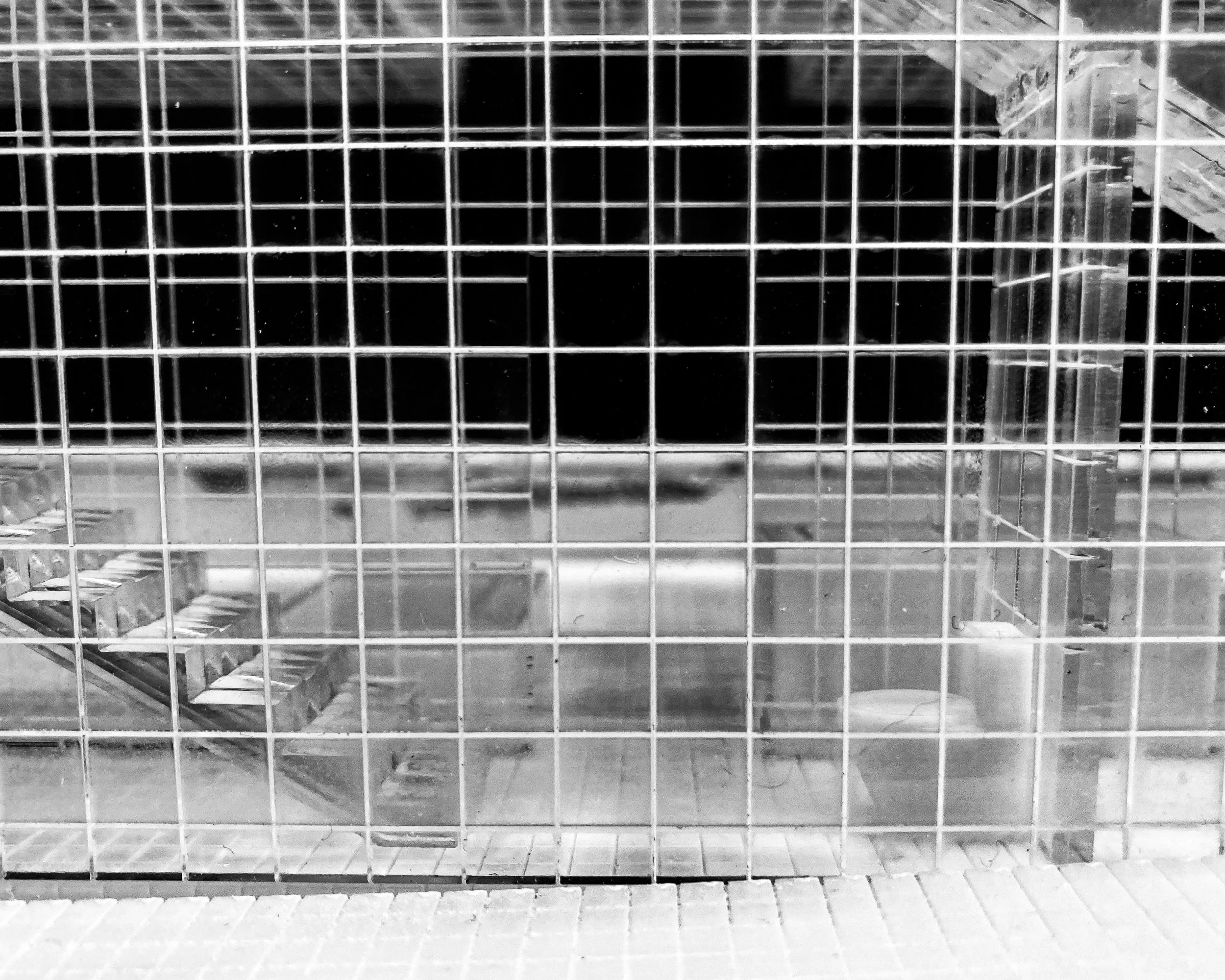
Andrew Spitzer Proximity VI
________________________________________________________________________________________
Andrew Spitzer is pursuing his Master's in Architecture at the University of Illinois, Chicago. Originally from Charleston, South Carolina, he is passionate about anticapitalist architecture and the ways in which architecture can project alternative futures. His work is inspired by the tension between performer/observer, intimacy/privacy, and interior/exterior. Andrew is currently developing a collaborative project with students at UIC. You can see more of his work and follow his collaborative projects on Instagram @a.spitz.er