The Shore Interview #60: Jingxuan William Zhuang
Questions by Ella Flores, Interview Editor
EF: Hi William, thank you for being up to do this interview! Your poem, “My Teacher Once Said To love” caught my attention for its many well-crafted aspects, but one that I wanted to focus on for this question is regarding its tempo. Every stanza contains at least one end-stopped line, almost every sentence interrupts itself with a comma break, the couplets are irregular in length and the entire poem is visually sandwiched by monostichs. All of this adds to a slowing effect, a recurring hesitance. How do you go about fine-tuning the tempo for a piece, in this poem or in other pieces? How do you tell if the tempo is working or not quite there yet? And are there specific effects you typically strive for?
JWZ: Thank you for sharing these thoughts! When I draft and edit a poem, I try to follow my intuition without verbally justifying each decision to myself, so it’s illuminating to know how you interpreted these moves.
I think what you called “a recurring hesitance” really captures how I approach syntax and line breaks. The phrase vocalizes a key element for my writing I didn’t know how to describe before. I have never been able to write in a fully direct tone, which I attribute to my avoidant personality.
It feels a lot more natural to burrow the speaker in sentences that pause, turn and interrupt themselves. The poetic form, with all of its elasticities, enables me to communicate in a style that would be really annoying in daily life.
In terms of tempo, when I have a draft, I read it out loud over and over. The line breaks usually correspond with my natural pauses, or when I see a chance to accentuate how a sentence can swerve around within the boundaries of grammar. An example of this would be “Resenting / the angle at which my elbow extends, / I walk the last mile home.” By reading aloud, I also locate the moments where something feels missing or extraneous. I feel out the lines’ ideal shape by pronouncing gibberish of various lengths and sounds. Once I find it, I try my best to fill it in with words.
EF: With a few journal publications now under your belt, can you tell me about your journey as a poet and how you got started sending your work out to magazines? Since getting your first poem published, how has that changed how you see the literary landscape when you see your work become a part of it?
JWZ: My attitude towards poetry changed a lot over the past two years or so. I’ve been writing poems casually since I was in high school and I got some poems published in campus magazines through my first two years at college, but I didn’t take the idea of being a writer seriously at all. I barely ever read poems. For whatever reason, I always thought I would grow out of writing and “mature” into “a normal person” who doesn’t write, I guess.
Two years ago, I took a workshop with the teacher who’s actually referenced in this poem. She was the first person who challenged me to push towards a certain direction instead of just giving one-off line edits. The rigor was new to me. I have since been hooked on the feeling of chasing specific effects with language, and I’m so grateful for the opportunities that have helped push me forward in this short time.
I started submitting work towards the end of last summer and seeing my work in a public context has definitely encouraged me to keep up my intensity towards the craft. At the same time, I feel very suspicious towards myself and the desire to be recognized. I don’t want my intention to be anything other than to make the piece that’s in front of me.
EF: Geography belies the entirety of “My Teacher Once Said To love” particularly in its seasonal position of cold January, the transit of the “I” through a city with seemingly public transportation and even the contrast of the winter with a cactus in a window. Being originally from Qingdao, China and now based in New York, how do you see geographical tension influencing or shaping your work? Perhaps adjacent to this question, how do you see having attended Tufts University in Boston informing your poetry now?
JWZ: I love the observation about the cactus, it’s so fun. That honestly was not done on purpose, but it’s always an honor to learn how people perceive my work and draw their own associations.
Growing up in China as a child, there was a strong emphasis on obedience. I was always afraid of making mistakes. Then, from when I was thirteen till graduating high school, I went to boarding school in the US. The environment was obviously very different and I wasn’t worried about the same things, but I still felt a lot of shame socially. I didn’t want to stand out, so I avoided expressing myself for the most part.
Arriving at Tufts was a revelation in that I was, all of a sudden, around kids who have felt similar frustrations. It was like delayed gratification, or this free-for-all of figuring yourself out. I ended up becoming reckless and self-indulgent, and spent a lot of time on what I would today call overcompensating.
But it’s not like the shame evaporated; it’s just more dormant. I now have two opposing forces that inform my personality, which I think shows in my writing. I want the speaker to be legible and striking, but also have a way out at all times. This poem, both in its images and statements, to me, gestures towards a feeling, but stops itself on a threshold.
EF: Are there any journals or magazines you're currently enjoying?
JWZ: For a while, I only read poetry from collections and anthologies. It made more sense to my brain to focus on one voice or theme over a sustained period of time. Then, when I moved to New York last fall, I worked at a physical therapy office as a receptionist. I found the work tedious, but I had a good amount of down time chopped up between tasks. My girlfriend had gifted me a New Yorker subscription and I spent a lot of my shifts reading random pieces from their archive. It was less conspicuous than reading a physical book on the clock.
When I got tired of the New Yorker, which was usually later in the afternoon, I would look up contributors to find their work elsewhere. It’s how I found The Shore. I also read stuff from places like the Washington Square Review, House House, the Margins, as well as lots of Poem-a-Days. If it were up to me, though, I would honestly still prefer books. (sorry!)
EF: Please speak to how two poems in this issue of The Shore (not including your own) are in conversation with each other.
JWZ: I love how “Dear Sounds” by Michelle Turner and “Distance, Closing Distance” by Samuel Dickerson, in their respective ways, associate the beloved with an atmosphere. “Dear Sounds” uses birds and music to give the emotions movement, while “Distance, Closing Distance” describes the lover with such attention that it makes the body a landscape.
It’s amazing how much sentiment can be imbued into images, turning them into agents of proclamation. It takes both abundance and restraint to do so. At the same time, it makes me think about how difficult it can be to address someone you love. I feel lucky poetry can help with this task.
________________________________________________________________________________________
Jingxuan William Zhuang is a writer from Qingdao, China. He has been in New York for a few months.
________________________________________________________________________________________
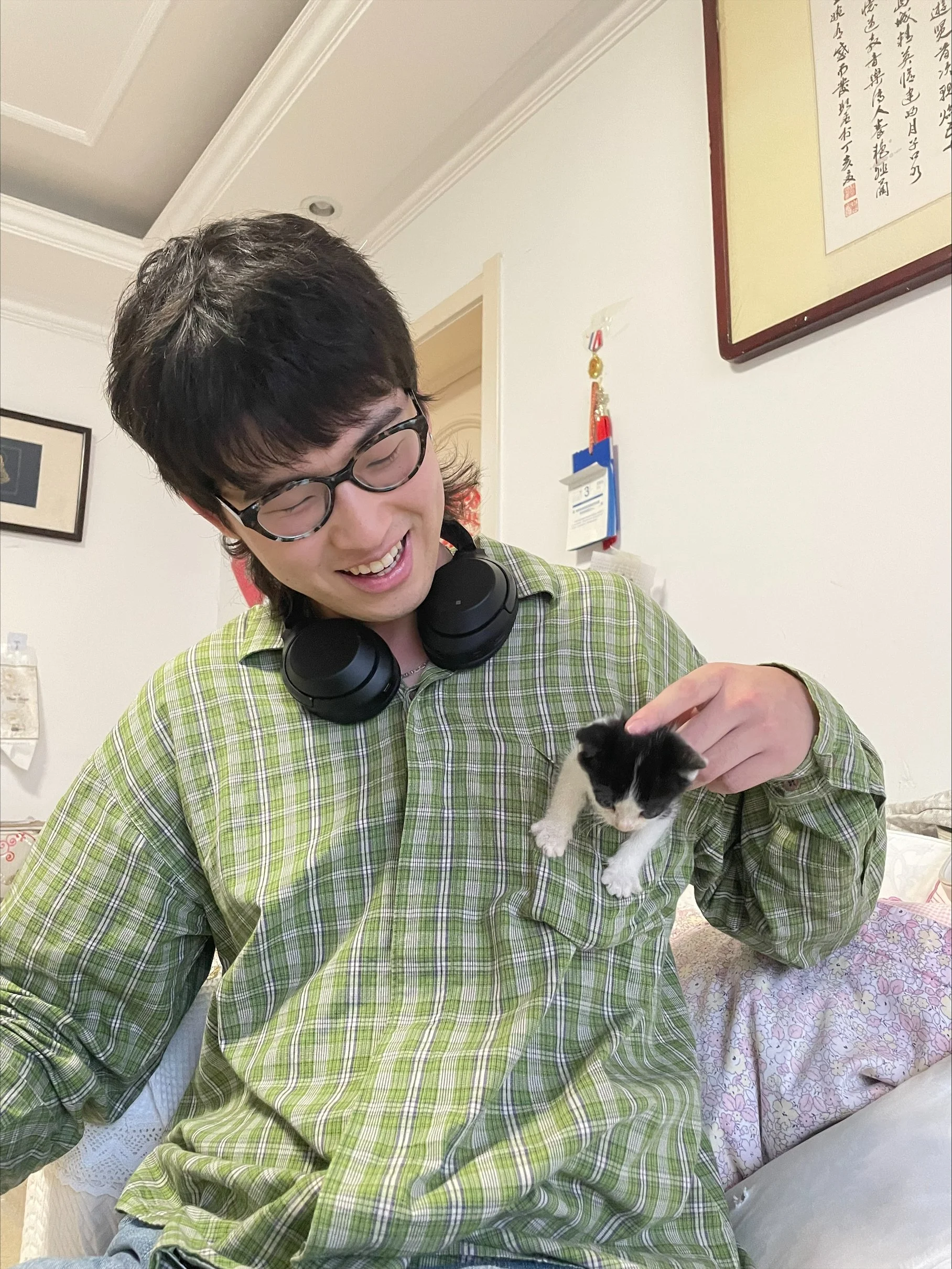
Jingxuan William Zhuang