The Shore Interview #58: Mary Buchinger
Questions by Ella Flores, Interview Editor
EF: Hi Mary, I’m so excited to have this chance to ask you these interview questions! To start off, I’d like to ask about your poem, “Librarie Jules Vernes, Paris,” specifically this bold move that you pull off beautifully in the opening of the poem where the only use of a parenthetical in the entire poem happens right in the second and third lines. As the reader enters the titular space, this move lifts the veil of the voice to reveal layers of associations and history that the voice is bringing into the space they enter. Here, it is Rilke’s work (is it Minot the cat?) but in a larger sense, can you take us through the process of when and how a craft choice like this feels like it works and are there similar moves you’ve considered like this but perhaps ultimately decided against in other work?
MB: The bookshop is real. Moments before walking in, I’d read (and taken a photo of!) a passage displayed on the wall of Shakespeare & Company, a much more famous Paris bookstore around the corner; it said: “Rainer Maria Rilke wrote about the little shops in the latin quarter, their windows filled with old books & etchings. Where nobody seemed to enter and the proprietor could be seen reading peacefully, indifferent to worldly success. Beside him lies a dog or perhaps a cat.” Having just read this description, I walked into this dusty, dim bookshop, the only light coming from the narrow space of the partly closed door to the street behind me. The room overflowed with books—on the floor, on tables, on shelves. Eventually, I spotted the proprietor at the back, perched on a stool, scrolling on her phone, seemingly unaware of my presence. Clearly this was one of Rilke’s bookshops, so where was cat?
As you suggest, Ella, I really did want to try to represent the experience of walking into this place and the upending of my expectations of a bookshop as an orderly place with a solicitous bookseller. And yes, our experience is always layered; so many instantaneous sets of thoughts and impressions. I struggle with this a lot in my work because I am particularly interested in the layers. Nothing is as it appears of course because ‘appearance’ itself is a construction that’s informed by what’s happened to us, what people have said to us, all the different things we’ve read, how we are feeling physically and emotionally, what we dreamt about the night before, etc. etc.—so much is happening all at once and how to bring that into poetry, to represent, in some way, the many, many layers, remains an invigorating challenge.
EF: As a follow-up to my previous question, your poem reckons so much with layers of time and language, and our corporeality through them. Words, for the poem, “rise / like bubbles from the boil” and are left to “mold / in this marooned room.” By the end of the poem, the “I” includes itself with the voices in those books, leaving the reader with a dual question and statement of “How else to tell our time / to strangers.” I could go on about how the lack of periods and other craft choices lend themselves to this continuous cycle of creating and receiving language. Whether or not this poem comes from a lived experience, can you tell us about your own experiences contemplating the price of “paper and imagination,” or your thoughts on the importance of spaces dedicated to this interaction of reader and writer?
MB: Thank you for this question! Near the bookshop is another storefront with this quote from James Baldwin displayed in the window: “You think your pain and your heartbreak are unprecedented in the history of the world, but then you read. It was books that taught me that the things that tormented me most were the very things that connected me with all the people who were alive, or who had ever been alive.” And so, I also carried Baldwin’s words with me into this space, thinking about all these books so casually strewn about the room, these waves of books at my feet, cascading off the tables, shoved into the shelves, in this dark, musty room, and yet, each book I opened had a price neatly written in pencil in the top right hand corner of the first page. All the books were hardcover, who knows how old, many bound in leather, gilt covers—they were beautiful material objects—but as a writer, I know what it takes to fill those pages with something meaningful and I found myself identifying with the authors, and thinking about my own books in closets and on bookshelves, and just what it means to have a writing life, a life that takes you beyond your own time, and then too, to think about a monetary value placed on this. Baldwin reminds us that we really only understand our life through the lives of others and that through reading we find that our own experience is both extraordinary and not—I was surrounded by accounts of lived lives, my own playing itself out among them!
In writing this poem, I found myself hesitant to use periods because it doesn’t seem like there is a full stop anywhere, as I am scanning the books and feeling very curious but also not knowing any French and not wanting to bother the proprietor who seemed annoyed at my having walked in—there was a kind of flow of emotion that I hope to capture with the form. The other images swimming around in my mind were those called up by the name of this bookshop, Jules Verne—I’d read Twenty Thousand Leagues Under the Sea and had seen the movie as a child and so, of course, I felt I was in the depths of something strange, books lapping against my feet, serpentine piles all around, it seemed a bit possible for me to drown in that place of words and time.
EF: I am so intrigued about your PhD in linguistics and how you ended up in teaching at the Massachusetts College of Pharmacy and Health Sciences! Can you tell us a little about what your primary focus was for your PhD? How have you seen the field change over time since your degree, if at all? And lastly, what unique perspective or tools do you see the study of linguistics as being potentially invaluable for a poet?
MB: For my dissertation, I studied classroom discourse; specifically I was interested (and continue to be!) in how, through conversation and working with materials, we construct an understanding of something complex. I studied interactions where children and adults were learning about buoyancy (funny to think about that in relation to Twenty Thousand Leagues Under the Sea!). Initially I studied linguistics because I’ve always been interested in language and it seemed somehow more practical than studying English literature, because, of course, linguists have more job opportunities than English majors… I’m not sure how my study of linguistics influences my writing, but I loved learning about the different elements of language and have always been especially fascinated by the sounds of words. As a sociolinguist, I am deeply interested in the power of words and word choices and try to remember and also encourage my students to consider the range of possibilities and the implications of communication for creating connection (or disconnection) and community, and, fundamentally, for changing the world.
EF: Are there any journals or magazines you're currently enjoying?
MB: Lily Poetry Review is one of my favorites— the newest issue is stellar, edited by Jennifer Franklin. I also enjoy reading Ibbetson Street, which is a local Boston-based poetry journal edited by Harris Gardner and Doug Holder. Public School Poetry is super cool—I love how poets engage with other poets’ work as they randomly assign each contributor to write a ‘five-paragraph essay’ on another contributor’s poem. Bracken is another favorite with its focus on writing about the natural world. I also have email subscriptions to The Sharpener, edited by Sean Singer, SWIMM, The Slowdown, Poem-A-Day, Poetry Daily, The Paris Review— I can't think of a better way to start my day then reading the poems that arrive in my mailbox.
EF: Please speak to how two poems in this issue of The Shore (not including your own) are in conversation with each other.
MB: Thank you for this opportunity—I appreciate being able to spend time with two of my very favorite poems in this issue, “Ephemeris (Mother)” by Avriel Mejrah and “Twice” by Lea Marshall. Both of these poems are poignant and revelatory as they draw on watery imagery to describe loss, memory and motherhood. “Twice,” dreamy and deep, opens up a space for wondering about existence, what it means to ‘be’ and to consider how memory may not depend on embodiment. This poem beautifully illustrates how dreams can reveal to us a life under a life. The complexity of our bonds to our loved ones is mysterious and that mystery is explored in both poems. In “Ephemeris (Mother),” the speaker’s mother is becoming unmoored from memory and we are made to contemplate the growing tenuousness of connection between them, which leads us to wonder about the very nature of our attachment to those dear to us. The house itself lists like a boat, “as if the house were only/a guess the body/keeps making.” These poems about embodied memory, love and grief invite the reader to reflect on how family relationships change and change us. I am grateful for where these poems take me.
________________________________________________________________________________________
Mary Buchinger is the author of eight collections of poetry; her most recent books are There Is Only the Sacred and the Desecrated (2026, Paul Nemser Book Prize Honorable Mention, Lily Poetry Review Books), Navigating the Reach (Honors, 2024 Massachusetts Book Award, Salmon Poetry), The Book of Shores (2024) and Virology (2022) both from Lily Poetry Review Books. Her work appears in AGNI, Plume, Salt Hill, Seneca Review and elsewhere. She holds a PhD in linguistics and teaches at the Massachusetts College of Pharmacy and Health Sciences. www.MaryBuchinger.com.
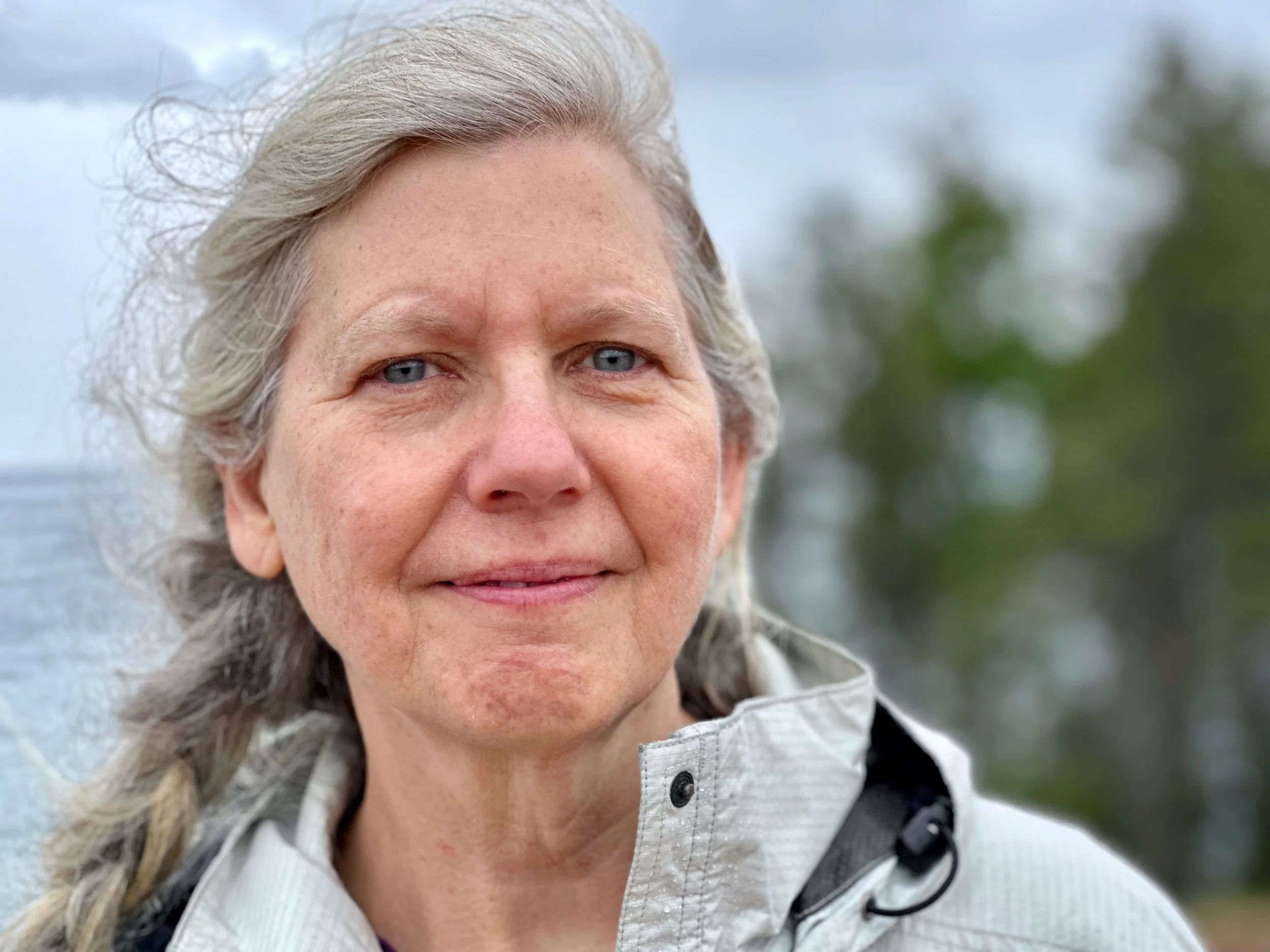
Mary Buchinger